
|
|
|
SHOP ONLINE:
|
| CONNECT: |
||
|
|
|
|||||||||
|
One of the most commonly used methods of potting up is called mold potting. While the method is very simple, it also minimizes the potential of shock caused by repotting. Your first step is to select an appropriate pot and a good potting soil (see below). After you have done this, take your new pot and put enough potting soil at the bottom to compensate for the difference in height. For instance, if your current pot is 2-1/2 inches in height, and your new pot is 3 inches in height, then the difference in height is 1/2 inch. You will, therefore, need to put 1/2 inch of potting soil at the bottom of your new pot. (Note: As you prepare your new pot, keep in mind that the final soil level should be about 1/2 to 3/4 inch below the rim of the pot.) After you have put soil at the bottom of your new pot, remove your African Violet from its current pot. To do this, simply place your hand over the top of the pot so that the crown of the plant is between your fingers. When doing so, be careful not to damage any of the leaves or stems. Next, turn the pot upside-down. If the pot is plastic, you will only need to push on the bottom of it to loosen the rootball. If the pot is clay, gently tap on the bottom of the pot to loosen the rootball. If this does not work, try inserting a pencil or some other device into one of the drain holes in order to ease the rootball away from the pot. If the rootball still does not budge, do not continue to push. By forcing the pencil into the rootball, you may damage the roots or even penetrate the crown. Instead, try sliding a butter knife between the pot and the rootball. However, only do this as a last resort, since the knife can easily damage your African Violet.
After you have removed your Violet from its old pot, set the Violet aside and place the old pot into the new one. Make sure the old pot is centered. Now, put potting soil around it until the soil is level with the height of where the rootball will be. The potting soil, which you are adding, should be packed tight enough so that it remains in place once you have removed the old pot. When you have done this, place the Violet (and its rootball) into the hole which you have just made. Finally, place your Violet and its new pot into a saucer of water. Allow the Violet to absorb whatever water it needs and, then, let any excess drain away. Once you have finished repotting, you many want to bag it. Many growers recommend this, asserting that the increased humidity helps African Violets recover from any transplant shock. To do this, place the African Violet into a clear, plastic bag which is large enough to accommodate the plant without damaging the leaves or stems. Seal the bag with a wire twist. Keep your Violet in the bag for one week. After you have removed the Violet from the bag, it will be safe to resume your normal watering and fertilizer schedule.
Another repotting procedure is called potting down a neck. Though it sounds similar, this procedure has nothing to do with potting down, as described above. In fact, when potting down a neck, you do not use a smaller pot. Instead, you use the same pot. The time to use this procedure becomes apparent when the neck of an African Violet becomes elongated. This happens, most often, when an African Violet is subjected to a disease or nutrient imbalance which predominantly affects the oldest leaves. These are the bottom-most leaves of an African Violet. As these leaves die off, the neck (sometimes called the stalk or main stem) of an African Violet becomes more and more exposed until it appears abnormally elongated, i.e., more than 1/2 inch long. Since all new growth originates from the center of the crown, the only way to correct this is to pot down the neck. The procedure for potting down a neck is simple and relatively safe to do. First, remove the Violet and its rootball from the pot. Starting from the bottom, you must cut away a section of the rootball equal to the length of the neck. Next, return the Violet to its pot. If it is seated properly, the bottom leaves of the African Violet will be resting on the rim. Now, add fresh potting soil up to the top of the neck, i.e., where the leaf stems issue from the main stem. Make sure that the new potting soil is pressed down firmly. Finally, give your African Violet water and let any excess drain. Because of the likelihood of shock, you should employ the bagging method (see above).
The pot that best suits an African Violet is called an Azalea pot. There are two ways to determine the correct pot size for your African Violet. When potting up, you should simply use the next largest pot size available. Pots for African Violets are available in increments of roughly one inch. Therefore, if you have an African Violet which is currently in a 2-inch pot, you will want to repot it in a 3-inch pot. Another way to determine proper pot size is to measure the diameter formed by the outer edge of an African Violet's leaves. Generally, if an African Violet is planted in the correct size pot, the diameter of its leaves will be about three times the diameter of the pot. Therefore, if the diameter of your African Violet's leaves measure 12 inches, then it should be planted in a 4-inch pot. 
Always make sure that your pot has adequate drainage. This is essential when watering from the top. When using a bottom-watering method, drainage becomes less important, since a good potting soil will only absorb the amount of water that an African Violet needs. However, whether watering from the top or the bottom, there will inevitably be times when it is necessary to thoroughly rinse the soil, e.g., when leaching the soil of excess fertilizer salts. Therefore, good drainage should always be taken into account when selecting a pot for your African Violet. If you have a pot which either provides no drainage or insufficient drainage, then holes should be added. On plastic pots, this can be done by using a soldering iron or by simply heating up the metal shaft of a screwdriver and pushing it through the bottom. On clay pots, use a drill. When doing so, do not press too hard. Go slowly and let the drill do the work. The size and number of holes depends on the size of the pot. On 4-inch pots, make as many as four holes, 1/4 inch in diameter. On 2-inch pots, make two holes, 1/8 inch in diameter. On 1-inch pots, make one 1/8-inch hole. The choice between clay pot and plastic pots
is one of preference. While African Violets can successfully be grown in
either one, each offers different benefits and drawbacks. An unglazed, clay
pot is porous. This allows a greater amount of aeration to the soil and
increases the amount of humidity around your Violets as water soaks through
the clay and evaporates into the air. For many, a clay pot also offers greater
aesthetic value, because it has a more traditional and/or natural look.
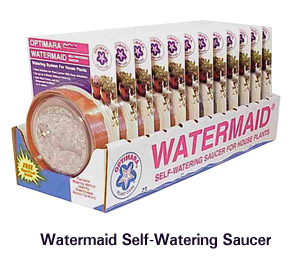
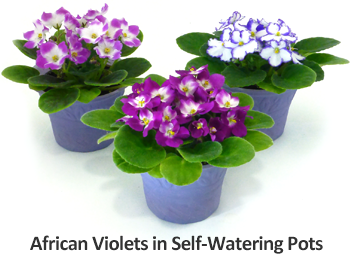
However, clay pots also have their disadvantages. When weighing the different advantages associated with clay pots and plastic pots, keep in mind that some of their respective drawbacks can be offset. For instance, the effects of accumulated fertilizer salts on clay pots can be minimized by placing aluminum foil or a coating of wax around the rim. When using plastic pots, you can compensate for the decreased humidity around the plants by misting, grouping your plants together or using a self-watering device, such as the Watermaid, which employs capillary matting.Aeration of the soil, in plastic pots, can be increased by using a recommended potting mix which is comprised of light, porous materials, such as block-harvested peat moss and perlite. And, of course, the aesthetic appeal of plastic pots can be enhanced with a decorative, self-watering device or a ceramic, outer container. One final consideration, in regard to clay versus plastic pots, is the
use of a self-watering device. Once you have chosen the correct pot for your African Violet, you will need to disinfect it. Disinfecting African Violet pots is vital, especially if you have one that has already been used. But even for new pots, disinfection is highly recommended. If you do not disinfect your pots, you run the risk of exposing your African Violets to Nematodes and other deadly micro organisms. The process is easy. Simply soak them in a 10 percent bleach solution, i.e., one part bleach to nine parts water. After soaking, rinse them with plain water.
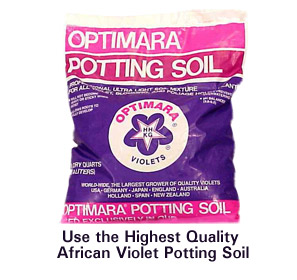
At first glance, the subject of potting soil may sound less important than it really is. This may be due to the fact that many people believe that "potting soil" is simply another name for "dirt." To be sure, there are products which claim to be potting soil for African Violets when, in fact, they are nothing more than dirt. These are heavy mixes which would easily crush the roots of African Violets. In addition, because heavy potting mixes hold so much water, they tend to leave African Violets vulnerable to such deadly pathogens as Crown Rot, Root Rot and Pythium. Moreover, many of these "dirty" potting soils do not even have the correct pH. This, in addition to their heavy quality, would further stifle an African Violet's ability to absorb the nutrients it needs.
While it is unlikely that potting soil from a reputable manufacturer will harbor unfriendly micro organisms, it may nevertheless be prudent to treat the soil before exposing it to your African Violets. The process for treating potting soil is called pasteurization. To pasteurize your potting soil, it must be heated to 180 degrees F for 30 minutes. This can be done by simply sealing the potting soil into heavy aluminum foil (minus the bag, of course) and placing it into your oven. By inserting a meat thermometer through the aluminum foil, you can monitor the temperature of the soil. Once the temperature reaches 180 degrees F, continue to heat it for 30 minutes. When the process is complete, remove the potting soil from the oven and let it cool. Once it has sufficiently cooled, you should seal it in a plastic bag or some other air-tight container in order to prevent contamination.   for the Latest Updates on African Violets & Exclusive Photos of New Varieties in Development!
  To order any of the products discussed on this page, visit Selective Gardener Copyright 1999-2002 Optimara/Holtkamp Greenhouses, Inc. Nashville, Tennessee. Doctor Optimara, the Doctor Optimara logo and Optimara Field Guide are trademarks of Holtkamp Greenhouses, Inc. Optimara, the Optimara logo, EverFloris, MiniWell, MaxiWell, WaterShip and Watermaid are trademarks of International Plant Breeding, A.G., Switzerland.
|
|||||||||
 Many successful growers of African Violets
recommend repotting with fresh potting soil, twice a year or more. At the
very least, an African Violet should be repotted whenever the plant becomes
rootbound, i.e., the Violet has outgrown its current pot to the extent that
its roots are growing out and around the rootball. This process of repotting
an African Violet into a larger pot is called potting up, and if you know
what you are doing, it is very easy to do and takes very little time.
Many successful growers of African Violets
recommend repotting with fresh potting soil, twice a year or more. At the
very least, an African Violet should be repotted whenever the plant becomes
rootbound, i.e., the Violet has outgrown its current pot to the extent that
its roots are growing out and around the rootball. This process of repotting
an African Violet into a larger pot is called potting up, and if you know
what you are doing, it is very easy to do and takes very little time.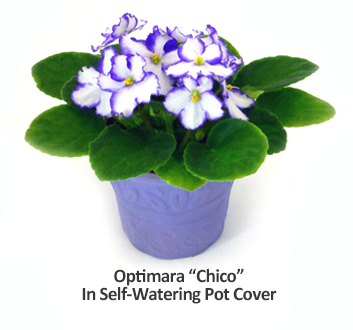
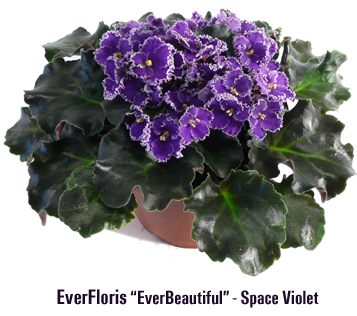 Aside from potting up, you may sometimes have
to pot down. Potting down is required when it is determined that an African
Violet is too small for its pot. Though rare, such instances become apparent
when a Violet is unable to form a cohesive rootball or when the soil remains
chronically soggy, even though the pot provides adequate drainage. When
potting down, use the next smallest pot size available. After removing any
excess soil from around the roots, gently shape the soil and roots until
you are able to squeeze them into your new pot. Because of the amount of
handling required for potting down, you should employ the bagging method
to minimize the effects of shock (
Aside from potting up, you may sometimes have
to pot down. Potting down is required when it is determined that an African
Violet is too small for its pot. Though rare, such instances become apparent
when a Violet is unable to form a cohesive rootball or when the soil remains
chronically soggy, even though the pot provides adequate drainage. When
potting down, use the next smallest pot size available. After removing any
excess soil from around the roots, gently shape the soil and roots until
you are able to squeeze them into your new pot. Because of the amount of
handling required for potting down, you should employ the bagging method
to minimize the effects of shock (
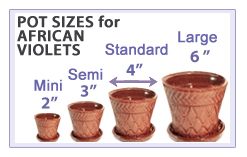 Compared
to a standard pot, an Azalea pot is relatively shallow. Whereas the height
of a standard pot is roughly equal to its diameter, as measured at the top,
the height of an Azalea pot measures only about three-quarters its diameter.
It is important to use an Azalea pot, because the roots of African Violets
tend to grow out more than they grow down. When planted in a standard pot,
this means that an African Violet's roots will not grow to the bottom of
the pot. As a result, the unused potting soil will remain soggy, thereby
reducing the amount of aeration that the roots receive and increasing the
potential for Root Rot or other deadly fungi.
Compared
to a standard pot, an Azalea pot is relatively shallow. Whereas the height
of a standard pot is roughly equal to its diameter, as measured at the top,
the height of an Azalea pot measures only about three-quarters its diameter.
It is important to use an Azalea pot, because the roots of African Violets
tend to grow out more than they grow down. When planted in a standard pot,
this means that an African Violet's roots will not grow to the bottom of
the pot. As a result, the unused potting soil will remain soggy, thereby
reducing the amount of aeration that the roots receive and increasing the
potential for Root Rot or other deadly fungi.